
This 7-day Uganda safari combines some of the country’s most rewarding wildlife experiences with a journey into northern Uganda. The itinerary begins in Entebbe and takes you to Ziwa Rhino Sanctuary, where you can track rhinos on foot, before continuing to Murchison Falls National Park for game drives and a boat cruise on the Nile.
From Murchison Falls, the journey continues towards Gulu, one of the main urban centres of northern Uganda, before exploring the culture and landscapes of the Acholi region. The route then returns towards Entebbe, giving you a taste of Uganda beyond the traditional safari circuit.
This itinerary is particularly suitable for travellers with one week who want to experience wildlife without spending the entire trip in the southwestern parks.
Day 1: Arrival in Entebbe
Your Uganda safari starts as soon as you arrive at Entebbe International Airport. Our driver will pick you up from the airport, welcome you to Uganda and help you with your luggage before transferring you to your hotel.
Entebbe is located on the northern shores of Lake Victoria and is surrounded by greenery. It is a relaxed introduction to Uganda after a long international journey.
If you arrive early, you can spend the afternoon exploring some of Entebbe’s attractions. The Uganda Wildlife Education Centre, commonly known as Entebbe Zoo, offers an introduction to Uganda’s wildlife and conservation work. You can also visit the Entebbe Botanical Gardens, where forest, wetland and lakeshore environments provide habitat for a variety of birds and monkeys.
Alternatively, you can simply rest at your hotel and prepare for the safari. In the evening, our driver-guide will brief you about the journey ahead, including the route, driving times and activities.
You can also use your first evening to sample some Ugandan food. Local dishes such as matooke, groundnut sauce, beans, beef stew, grilled fish and the popular rolex provide a good introduction to the country’s cuisine.
Accommodation: Budget guesthouse, mid-range hotel or luxury hotel.
Day 2: Entebbe to Ziwa Rhino Sanctuary and Murchison Falls
Driving time: About 6–8 hours excluding the rhino experience and other stops
After breakfast, our driver-guide will pick you up from your hotel and we will begin the journey northwards. The first major stop is Ziwa Rhino Sanctuary, located in Nakasongola District. The journey takes you through the countryside, with changing views of farmland, trading centres, roadside markets and rural communities.
Ziwa is particularly important because it is home to Uganda’s growing population of southern white rhinos.
Unlike seeing rhinos from a safari vehicle, rhino tracking here is conducted on foot with trained rangers. You will learn about rhino conservation, their behaviour and the efforts being made to protect the animals.
The walking experience also gives you an opportunity to appreciate the surrounding landscape. Your ranger will explain how trackers locate the rhinos and how the sanctuary protects them. After the experience, we continue north towards Murchison Falls National Park.
More about Murchison Falls National Park
Murchison Falls is Uganda’s largest national park and one of the country’s best-known wildlife destinations. The Victoria Nile passes through the park before being forced through a narrow gorge at Murchison Falls.
The park’s savannah supports elephants, giraffes, buffaloes, Uganda kob, hartebeest, hippos and several other species. Lions are also present, while leopards can sometimes be spotted by fortunate visitors.
We continue towards our lodge, arriving later in the afternoon or evening depending on the timing of the rhino tracking experience. The evening is available for relaxation.
Accommodation: Budget campsite/lodge, mid-range safari lodge or luxury lodge.
Day 3: Murchison Falls game drive and Nile boat cruise
Activities: Morning game drive, Nile boat cruise and Murchison Falls
We wake up early for one of the main highlights of the safari: a game drive through the northern sector of Murchison Falls National Park.
The morning is a good time for wildlife viewing because temperatures are generally cooler and many animals are active.
As we drive through the savannah, we will look for elephants moving between feeding areas, giraffes browsing on trees and large herds of buffaloes and antelopes.
The Uganda kob is particularly common in the park’s grasslands. These antelopes form an important part of the food chain and are also among the species that attract predators such as lions.
We may also encounter warthogs, Jackson’s hartebeest, oribis and waterbuck. Lions may be found resting in open grassland or under trees, while leopards are more difficult to spot because of their secretive behaviour.
After the game drive, we return to the lodge for lunch before heading to the Nile for an afternoon boat cruise.
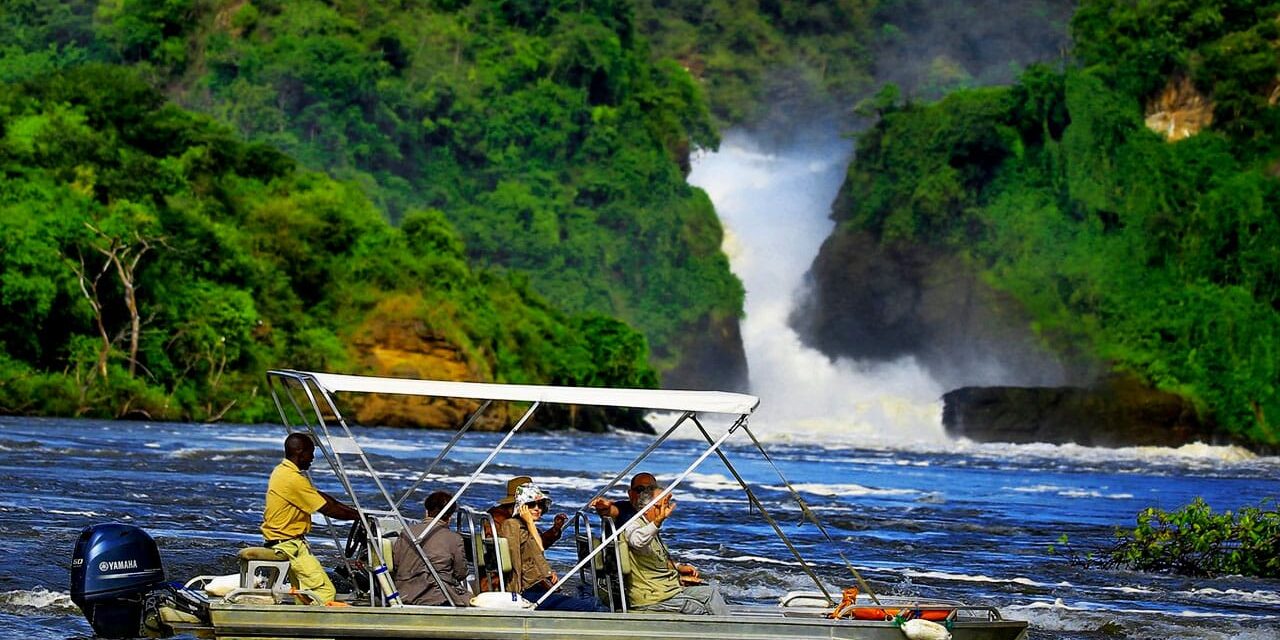
The boat cruise takes you upstream towards the base of Murchison Falls. The riverbanks are often alive with wildlife. Hippos spend much of their time in the water, while crocodiles can be seen resting along the banks. Elephants and buffaloes may approach the river to drink.
The cruise is also an excellent birdwatching experience. Depending on the season and location, you may see African fish eagles, kingfishers, herons, cormorants and other water-associated species.
As the boat approaches the falls, the sound of rushing water becomes stronger. The Nile is forced through a narrow gorge before plunging downstream, creating the dramatic waterfall that gives the park its name.
After the boat cruise, we can visit the Top of Murchison Falls if time and park conditions allow.
From the top, you can see the river compressed into the narrow gorge. The viewpoint also provides excellent opportunities for photographs. We return to the lodge in the evening.
Accommodation: Same as Day 2.
Overnight: Murchison Falls National Park.
Day 4: Murchison Falls wildlife and Gulu
We begin the morning with another wildlife experience before leaving Murchison Falls.
Depending on your interests, we can take an early game drive through a different section of the park. This gives you another opportunity to search for wildlife that may not have appeared during the previous day’s drive.
A second game drive can also provide a completely different experience because wildlife movements change from day to day. After breakfast or the morning game drive, we leave the park and continue towards Gulu, one of the most important towns in northern Uganda.
Gulu is the largest urban centre in the Acholi sub-region and has become an important commercial, educational and cultural centre in northern Uganda. The region has a strong Acholi cultural identity, expressed through traditional music, dance, food, crafts and community life.
Travelling through northern Uganda also gives you a different perspective of the country. The landscape becomes more open, with extensive grasslands, farms and villages spread across the countryside.
Rather than treating Gulu simply as an overnight stop, we can use the afternoon to explore parts of the town and learn about the region. You may visit local markets, craft shops or community projects, depending on what is available and your interests.
One of the interesting aspects of the region is its traditional food. Depending on the season and local availability, you may encounter dishes based around millet, cassava, beans, greens, sweet potatoes and other locally grown foods.
The evening can be spent relaxing at your hotel.
Accommodation: Budget hotel, mid-range hotel or higher-end hotel in Gulu.
Day 5: Gulu and Acholi Cultural Experience
This day focuses on a side of Uganda that is often missed on conventional wildlife safaris: northern Uganda’s culture and communities. After breakfast, we explore the Gulu area and, where arrangements permit, visit a local community or cultural initiative.
The Acholi people have a rich cultural heritage, with traditional dance, music, storytelling, crafts and communal activities playing important roles in cultural life.
A cultural experience can include demonstrations of traditional food preparation, crafts or music and dance. Rather than simply watching a performance, we encourage travellers to use the opportunity to learn about the meaning behind the traditions.
The region’s history is also an important part of understanding northern Uganda. Communities in this area experienced decades of conflict, which affected families, livelihoods and local development. Today, northern Uganda continues to develop as tourism, agriculture, trade and other economic activities grow.
We can also explore the surrounding countryside, where small farms and villages provide a glimpse into everyday life outside Uganda’s major cities.
For travellers interested in photography, this is an excellent opportunity to capture rural landscapes, local markets and traditional architecture, while always respecting people’s privacy and asking permission before photographing individuals.
Food can be an important part of the cultural experience. Depending on what is available, you may try northern Ugandan staples such as millet bread, cassava, sweet potatoes, beans and locally prepared greens.
You can also enjoy more familiar Ugandan dishes such as matooke, rice, beef, chicken and fish.
The afternoon can be relaxed, giving you time to explore Gulu town or rest at your hotel.
Accommodation: Same as Day 4.
Day 6: Gulu to Ziwa Area
Driving time: About 5–6 hours
After breakfast, we leave Gulu and begin travelling southwards for 5-6 hours. The journey gives you another opportunity to appreciate how much Uganda’s landscape changes from one region to another.
As we travel towards central Uganda, you will pass through villages, agricultural areas and small trading centres. Roadside markets provide an interesting glimpse into local commerce, with traders selling fruits, vegetables, roasted maize and other produce.
We can make short stops along the way where appropriate.
Rather than rushing to our accommodation, the day can be treated as a relaxed travel experience. Our driver-guide will help you understand the different regions we pass through and point out interesting places along the route.
We eventually reach the Nakasongola area, where we spend the night before continuing to Entebbe the following day.
Nakasongola sits within Uganda’s central-northern transition zone. The area is characterised by relatively dry savannah landscapes compared with the greener highlands around Kampala and western Uganda. It is also an important cattle-keeping region. Along the road, you may see herds of cattle and traditional grazing practices.
The region provides a useful contrast to the forested and wetter environments experienced earlier in the safari. The evening is free for relaxation.
Accommodation: Budget guesthouse, mid-range lodge or hotel
Day 7: Nakasongola to Entebbe
After breakfast, we begin the final drive towards Entebbe; about 4-5 hours drive.
If your flight is later in the day, we can make a few stops along the way depending on your interests and available time. As we approach Kampala and Entebbe, the countryside gradually gives way to busier roads, towns and urban areas.
Our driver will drop you at Entebbe International Airport for your departure flight or at your hotel if you are staying another night in Uganda.
Your seven-day safari ends with a combination of wildlife, conservation, culture and countryside experiences.

3 Comments