Ever wondered how a small creature could excite an entire nation! Imagine arriving in Uganda in November and discovering that the whole country is waiting for insects to appear. Not butterflies. Not birds. Not the lions of Queen Elizabeth National Park or the mountain gorillas of Bwindi. Grasshoppers!
And not just any grasshoppers. These are nsenene, a seasonal delicacy so deeply loved that their arrival can turn ordinary evenings into something resembling a national celebration.
As the November rains settle in, conversations begin to change. People start asking whether the grasshoppers have appeared. Vendors prepare their cooking stations. Traders watch the markets. Somewhere, someone is already checking where the freshest catch can be found.
Then the season arrives, and Uganda seems to develop one shared appetite. For visitors unfamiliar with the tradition, the excitement can be bewildering. Why would people stay awake waiting for insects? Why are roadside vendors suddenly selling them everywhere? And why does a small container of fried grasshoppers attract so much attention? And hey, why does it cost so much!
Welcome to Uganda’s nsenene season, where one of the country’s most unusual culinary traditions becomes one of its most anticipated annual experiences.
When November arrives, Uganda starts looking towards the skies
The joy that fills Ugandan households when November rains come.
There are several ways to know that November has arrived in Uganda. The rains return in many parts of the country, the countryside becomes greener, and the evenings begin to carry a familiar sense of anticipation.
For many Ugandans, however, there is another sign. Nsenene are coming! These edible insects are scientifically known as Ruspolia differens. They are commonly called long-horned grasshoppers, although they are technically katydids. They are found in several parts of East Africa and are particularly popular as food in Uganda.
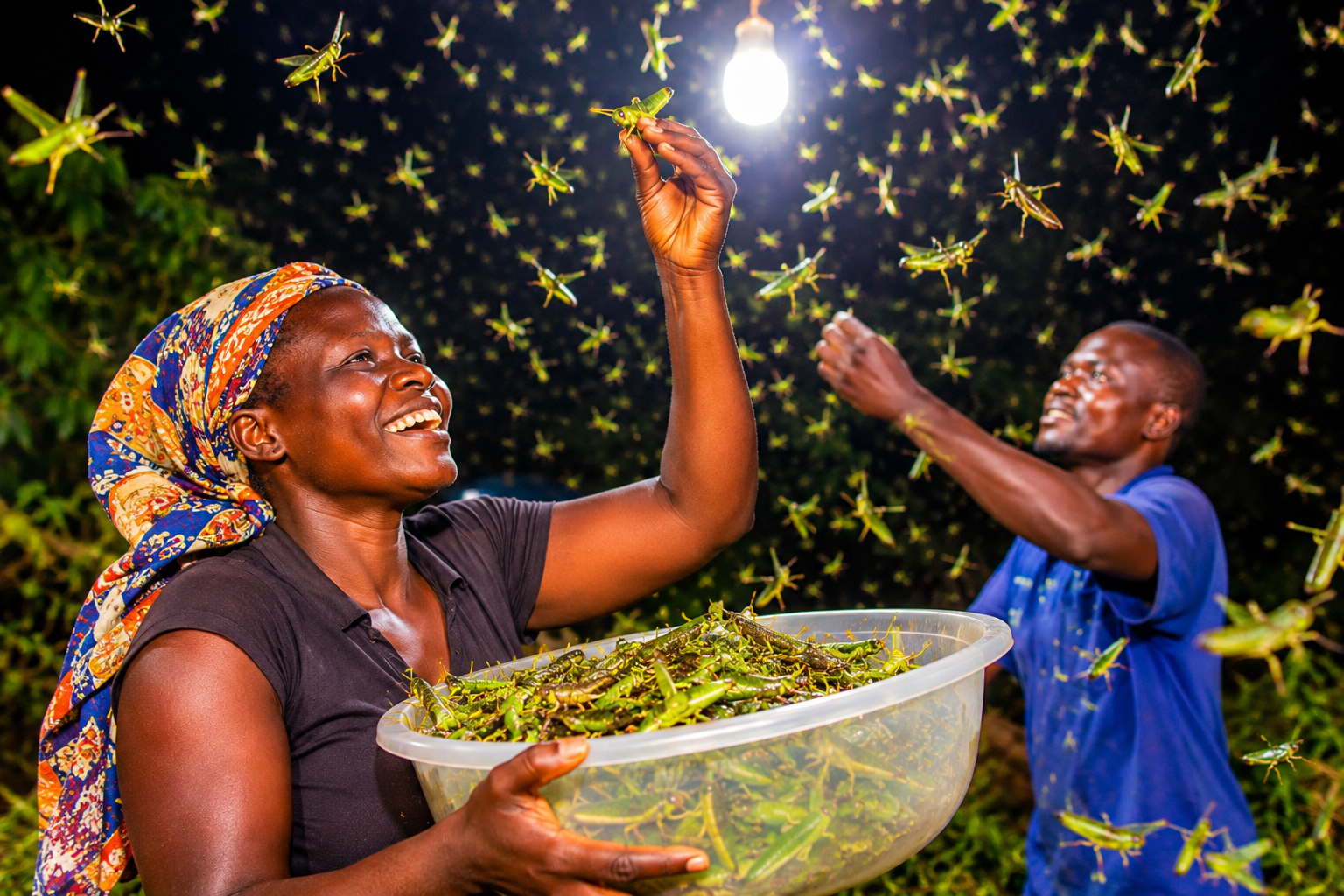
Their appearance is seasonal, with two commonly recognised periods around April to May and November to December. However, the exact timing depends on weather conditions, rainfall and location. When conditions are favourable, the insects emerge in large numbers. They are attracted to artificial lights, which makes towns, trading centres and rural communities active harvesting locations.
This is when the real excitement begins. You might see people gathering around bright lights at night, waiting for grasshoppers to land. Others use specially designed traps to collect them. In some places, harvesting becomes a family or community activity.
For outsiders, it might look like an unusual nighttime gathering, perhaps a ritual! For Ugandans, it is the beginning of a much-loved food season.
The grasshoppers that bring Uganda together
Uganda is a country with a remarkable food culture. Every region has its own ingredients, cooking traditions and dishes that tell stories about the people who live there.
Yet few seasonal foods generate quite the same excitement as nsenene. Ask a Ugandan about grasshoppers and you are likely to get a strong opinion. Some people love them so much that they begin looking forward to the next season almost immediately after the previous one ends.
Others prefer to wait until someone has prepared them before joining the feast. And, of course, there are people who cannot imagine putting an insect anywhere near their mouths. Then there are those that are forbidden to touch or eat them because it is their clan’s totem.
That is all part of the fun.
During the season, conversations about nsenene spread through workplaces, homes, markets and social media. People share photographs of their purchases, compare prices and discuss where the best grasshoppers are being sold. Do not get surprised when you are served nsenene on your Uganda Airlines flight!
There is also a certain competition around who can find the freshest supply. For Ugandans living abroad, the season can bring back memories of home. A photograph of freshly fried nsenene can be enough to start a conversation about childhood, family gatherings and the familiar excitement of November.
It is food, certainly. But it is also nostalgia, community and a little bit of national obsession.
So, what do nsenene actually taste like?

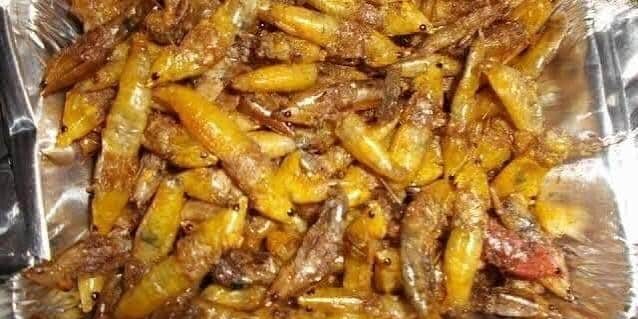
grasshoppers have a distinctive aroma and taste that are hard to compare with any other food
This is usually the first question from anyone who has never eaten them. The answer depends on how they are prepared, but properly cooked nsenene are commonly described as crunchy, savoury and rich in flavour.
Some people compare their taste to roasted nuts. Others simply insist that nothing quite compares to freshly prepared grasshoppers.
The preparation begins with cleaning. Traditionally, the wings and legs are removed, one by one, although methods differ between households and vendors.
They are then cooked, often by frying them in their own natural oils. Onions and salt are common additions, while some cooks introduce chilli or other seasonings.
As they cook, the grasshoppers develop a distinctive aroma. Their colour changes, their texture becomes crispier and the kitchen starts to smell like a very Ugandan November.
The finished product is usually served as a snack. Some people enjoy them while still warm. Others buy larger quantities to take home and share with family. You will also find vendors selling prepared nsenene in markets and along busy roads during the season.
For first-time visitors, the best introduction is probably a freshly prepared portion from a reputable food vendor. And here is a little advice: do not judge the experience before tasting it. You might be surprised.
A night-time harvest that turns insects into income

Grasshoppers are attracted to extremely bright artificial light. This picture shows how grasshoppers are harvested in large quantities in Uganda
Behind the excitement is an interesting seasonal economy. Nsenene are not simply collected for household consumption. Their arrival creates business opportunities for harvesters, traders, transporters, market vendors and restaurants.
For some people, the grasshopper season is an important source of seasonal income. Harvesting can take place at night, particularly when the insects are attracted to artificial lighting.
In areas where grasshoppers are abundant, people organise their collection equipment and prepare for the arrival of the insects. Some use traps fitted with lights, while others rely on different traditional harvesting methods. Once collected, the grasshoppers enter a supply chain that can stretch from rural harvesting areas to urban markets.
Kampala, for example, becomes an important destination for the seasonal trade. Vendors sell fresh or prepared grasshoppers, while restaurants and roadside food businesses take advantage of the increased demand.
The price can vary considerably depending on supply, location and the stage of the season. When grasshoppers are scarce, demand can push prices higher. It is a fascinating example of how a natural seasonal event supports livelihoods.
However, the trade also raises important questions about sustainability. Harvesting practices, artificial lighting and the use of chemicals can affect insect populations and the wider environment. Responsible harvesting and food safety therefore matter.
Where can visitors experience Uganda’s nsenene craze?
If you are visiting Uganda during November, experiencing the grasshopper season can add an unexpected dimension to your trip. You do not need an expensive restaurant reservation or a specially organised safari. Sometimes, the best introduction is found in a local market or at a roadside food stall.
Kampala is an obvious place to begin. The city has a lively food culture, and seasonal vendors become particularly noticeable when grasshoppers are available.
You can explore local markets, speak to food sellers and discover how different people prepare their nsenene. Some restaurants also feature grasshoppers on their menus during the season.
Outside Kampala, visitors travelling through towns and trading centres may encounter vendors selling freshly harvested or cooked grasshoppers. This is where travelling by road becomes particularly interesting.
A journey through Uganda is not only about reaching national parks and accommodation destinations. It is also about the unexpected stops along the way. You might pull over for a photograph, discover a local market, meet a food vendor or find yourself tasting something you had never considered eating.
These spontaneous encounters often become some of the most memorable parts of travelling.
For anyone exploring Uganda in a rental vehicle, November offers an opportunity to experience the country beyond its famous wildlife attractions. A road trip can become a culinary adventure, with local food, seasonal markets and everyday community life forming part of the journey.
Just remember to choose hygienic vendors and avoid insects collected from areas treated with pesticides.
Beyond grasshoppers, Uganda’s food culture deserves a journey of its own

Ugandans don’t wear Rolexes. They eat them. Here is one of Uganda’s most celebrated street food, the Rolex.
Nsenene might be the headline attraction in November, but Uganda’s culinary identity stretches far beyond grasshoppers. Every journey through the country introduces visitors to different flavours and traditions.
In central Uganda, matooke remains a household favourite. The green cooking bananas are steamed, mashed and often served with groundnut sauce, beans, meat or traditional stews.
Then there is luwombo, a celebrated dish in which ingredients such as chicken, beef or groundnuts are cooked in banana leaves. The slow cooking process produces a distinctive flavour that has made it an important part of Ugandan cuisine.
Street food lovers should not leave without trying a rolex. This popular combination of chapati and an omelette is one of Uganda’s most recognisable street foods. It is affordable, filling and available in countless variations.
Travelling towards eastern Uganda introduces visitors to malewa, a traditional dish made from smoked bamboo shoots. In the west, visitors may encounter eshabwe, a rich traditional sauce associated with Ankole culture.
There are also traditional drinks, roasted meats, fresh tropical fruits and regional specialities waiting to be discovered. What makes these experiences special is that they are not always presented as formal tourist attractions. They are part of everyday Ugandan life.
Sometimes, all you need is curiosity, a little time and a willingness to try something unfamiliar. Learn more about Uganda’s culinary gems here
Is November the best time to visit Uganda for a culinary adventure?
November is an interesting month for travellers interested in experiencing Uganda beyond its traditional safari circuit. It is one of the slow tourist months so most safari destinations are less crowded compared to the peak seasons of June to September and December to February.
It is is also one of the country’s rainy-season periods, so visitors should prepare for occasional heavy showers and changing road conditions. However, rain does not mean that travel comes to a complete stop.
National parks, cultural attractions and towns remain accessible, although some routes can become challenging, particularly in remote areas.
The grasshopper season adds a distinctive cultural experience to the month. Visitors can combine food exploration with sightseeing, wildlife experiences and encounters with local communities.
You could spend a few days discovering Kampala’s food scene before travelling towards Jinja, where the Nile offers opportunities for adventure and relaxation.
Alternatively, you could explore western Uganda, visiting Lake Mburo, Queen Elizabeth National Park or the communities surrounding Fort Portal.
For travellers with more time, the journey could continue towards Bwindi Impenetrable National Park for gorilla trekking, subject to permit availability and advance planning.
The important thing is not to treat nsenene as the only reason to visit. Rather, consider them one of the many experiences that make Uganda worth exploring.
A taste of Uganda that you will not easily forget
There is something wonderful about discovering a country’s culture through the things its people love. In Uganda, nsenene offer precisely that opportunity. They tell a story about the seasons, the environment, traditional food knowledge, small businesses and the connections people share through food.
They also challenge visitors to look beyond what they already know. You may arrive in Uganda expecting gorillas, elephants, lions, waterfalls and beautiful landscapes. You may leave remembering the first time someone convinced you to taste a plate of fried grasshoppers.
And perhaps that is what makes travel so rewarding. The experiences you remember most are not always the ones you planned. So, if November finds you travelling through Uganda and you notice people gathering around food stalls, asking about fresh grasshoppers or enthusiastically discussing the latest harvest, do not be too quick to walk past.
Stop for a moment. Ask questions. Watch how they are prepared. Find out why everyone is so excited.
Then, if you are feeling adventurous, order yourself a portion.
Because in Uganda, November is not just another month on the calendar. It is nsenene season, and the whole country has a reason to celebrate. You might be in luck and the nsenene season pushes into part of December.